
Books Vol. 21
mayhaps are we having pussy for breakfast???? lol jk... unless?????

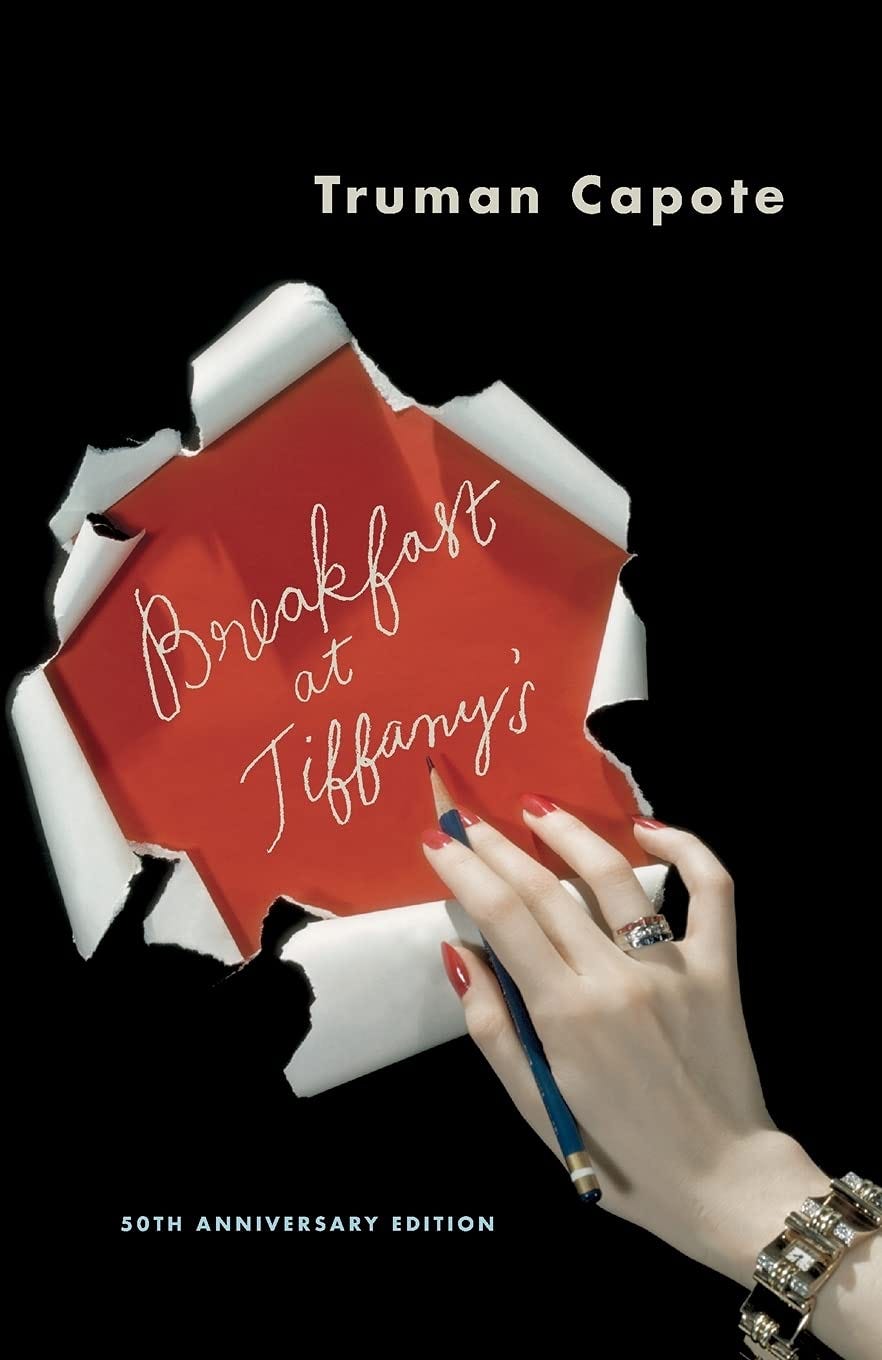
Truman Capote - Breakfast at Tiffany’s (1958)
The novella: a wonderful form of writing, perfect for small, self-contained yet deep storytelling, has fallen into woeful disrepair. With modern fiction’s center of gravity located almost exclusively on the novel as its primary structure, other, shorter forms- novellas, short stories, etc.- have nearly disappeared from the public eye. Breakfast at Tiffany’s is an object lesson in why that’s such a tragedy; beautifully composed and impressively sumptuous despite the leanness of its page count, it stands proudly amongst Capote’s longer and more “substantial” works. Of course, it’s not merely its length which has caused this book to fade from view; the shadow of its 1961 film adaptation looms heavily over it, memories of the ink and paper form silently replaced with those of celluloid. Breakfast at Tiffany’s, the film, is a charming, light, coquettish little number which received its classic status honestly. But it’s also a less substantial work than the novella it’s adapted from, with numerous changes large and small to the original text which simplify and clean it up substantially. The movie is very good; the book is great, and its greatness is found in that complexity which would make an unaltered version of the text so unsuitable for film. To be very direct: watching the film does not replace the experience of reading the book, and both are highly recommended.
If there’s one particular quality in Capote’s writing that sets him apart from his contemporaries- putting aside his wonderfully clean yet evocative prose, wit, and economical pacing- it’s a nearly unparalleled emotional subtlety. Breakfast at Tiffany’s’ unnamed narrator, an archetypal Sensitive Young Man, is one who attempts to maintain a wry distance even while utterly ensnared by Holly Golightly, debutante-around-town who forms a perfect midpoint between the maneaters of the early 20th century and the manic pixie dream girls just past its end. The film strips the story down to a kind of meet cute romcom, while the book trades in something more achingly authentic: a character study of a woman impossible to ignore and equally impossible to truly connect with, whose infinite wellspring of charisma and raw sensuality composes a kind of armor against sincere connection. Shades of The Great Gatsby leak through, where insistent warmth disguises an unreachable, painful distance between people. The narrator’s unspoken love for Holly is utterly doomed; she is a woman nearly incapable of genuine emotional vulnerability, which invariably only increases her intrigue. Just about every sensitive young man with an artistic streak has been hopelessly infatuated with a Holly at one point or another in his life- I’ve had a few of my own, of course- and it’s in this verisimilitude that the painful emotional heart of the novella beats steadily underneath its raucous partying and flippant attitude.
Were the work merely a depiction of unrequited limerence, it would be very good but not exceptional. What sets it apart from similar pieces is the emotional shading within it. Capote focuses pointedly but quietly on the ugliest aspects of such a passion: the humiliation, the jealousy, and the resentment which roil underneath its seductive surface. Its conclusion is ambitious in its seeming dissatisfaction, with an understanding of the importance of release, desperate fists unclenching rather than being dragged down into deeper waters. Its final pages have a kind of mystical power to them. To all sensitive young men: remember the cat in the window. Remember that you can only choose your own place, not anyone else’s.
(Addendum: like most modern editions of the book, my copy comes with three short stories, all of which are excellent, the final entry, “A Christmas Memory,” being among the finest short stories I’ve ever read. I didn’t cry, but I came far closer than I’m comfortable with. They should not be skipped.)
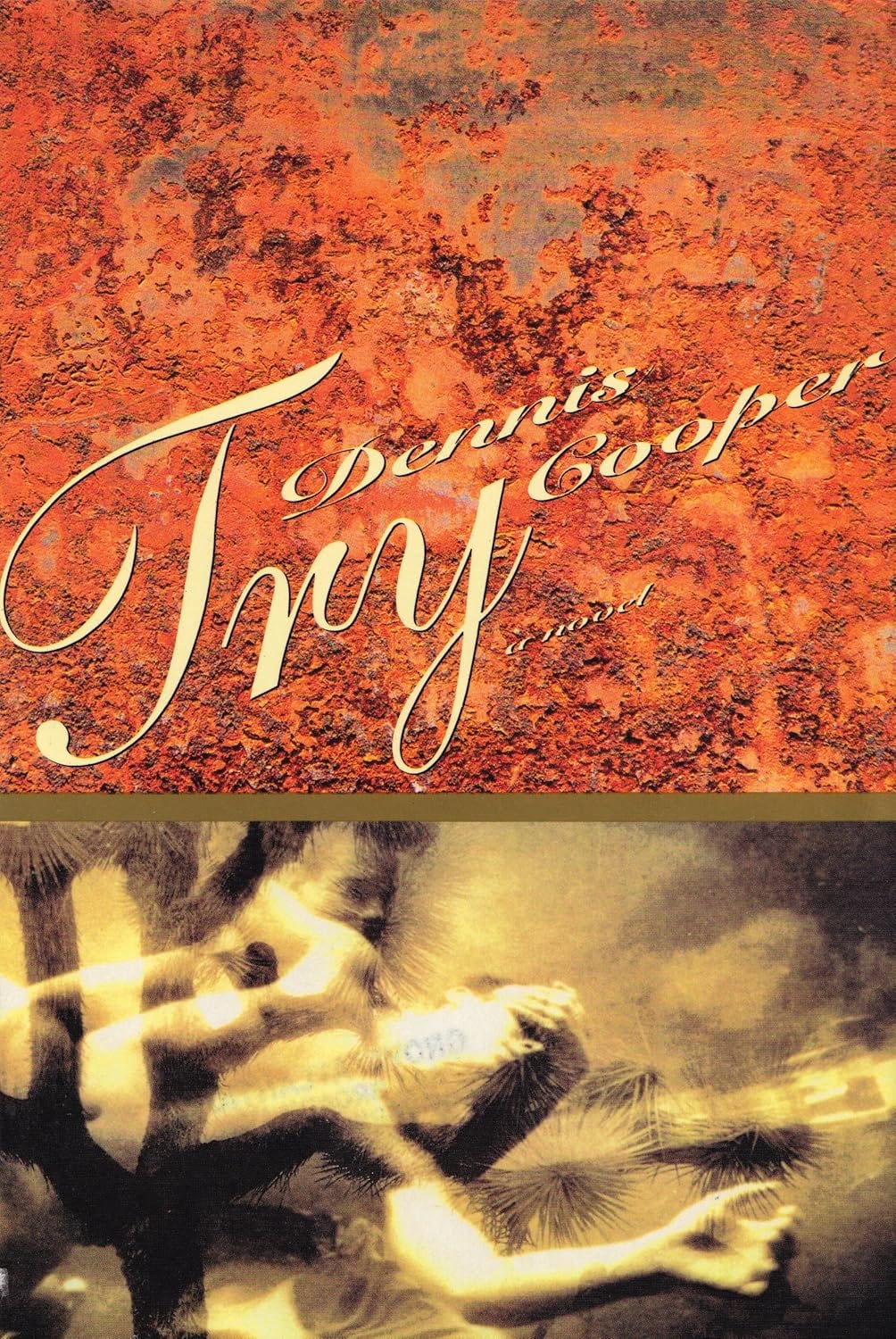
Dennis Cooper - Try (1994)
If Frisk represented an impressive turn toward a kind of Sotosesque ideological honesty, Try represents an about-face and sprint away from it; it drips with desperation and rationalization, as though Cooper is frantically grasping at whatever remains of youth and romance he can find as he descends into a stultifying midlife crisis defined more by mindless repetition than outward childishness. Try is the worst of the George Miles cycle- worse than Closer, an even more glib and formless work than that novel, where themes are cobbled together out of sheer proximity more than any structural relationship. If we map the George Miles cycle onto the Kübler-Ross model of grief- which is pretty easy to do, here you go, I found your shitty undergrad queer lit essay prompt- Try would fall into bargaining, which seems quite appropriate. It is a novel that speaks far more to the neuroses of the author than its own themes or narrative; its inherent absurdity seems like a manifestation of an overwhelming yet still unmapped guilt, the last gasps of Cooper’s pathetic tendency toward rationalization hidden under a cloak of artificial self-loathing and mercenary empathy. It’s a fascinatingly instructive piece as to the mental state of Cooper at the time; it’s also a terrible book.
Instead of one George Miles stand-in, we now get two: Ziggy, the Most Raped Boy in the World, and Calhoun, a heroin-addicted mannequin who seemingly exists merely to represent generalized 90s malaise and little else. If Frisk announced the death of the 80s and the gay party scene in general, responding to the ever looming fear of AIDS, Try shows Cooper trying to wrap his head around the emotional core of a new decade: in this case, a variety of petty, self-indulgent nihilism which treats all suffering as some form of extended martyrdom, no matter the source (Try is Cooper’s most Catholic novel, which would be interesting except that he’s not a Catholic.) While Try is measurably less extreme in terms of content than Closer or Frisk, it’s far more melodramatic than either: where other Cooper books observe their insane obscenities with a dispassionate, even sterile gaze, Try is constantly fucking blubbering and insisting on how tragic its endless cavalcade of abuse and suffering is, as though the author could not rely on us to understand savage child rape as sufficiently dispiriting on its own (which, I think, says far more about Cooper than the audience.) Cooper seems to be in a race against himself, perpetually upping the ante of human cruelty, prodding at the reader: “Don’t you see how bad this is? What if it was worse? Would you cry then? C’mon, doesn’t this make you consider the heartbreaking earnestness of adolescence and the unspeakable crime that is robbing the youth of its innocence?” Which in and of itself seems like a sort of rhetorical motte-and-bailey: by showing you behaviors and characters so far beyond the pale, Cooper suggests that his own crypto-pedophilia just isn’t so bad when taken in the context of the most ridiculous excesses imaginable. Come on, Dennis- we know what you’re about. If you want to attempt to trick yourself, that’s fine, but don’t drag us along for the ride.
All of this could be easy to handwave- it’s mostly just highly exaggerated versions of problems which are inherent to Cooper’s writing- if the book wasn’t so obnoxious and cloying on a line-by-line basis. Cooper’s already excessive tendency toward comically introspective monologue is driven far past its breaking point in Try, to the point where I honestly had to question whether its intent was parodic. Hardly a page can go by without one of the book’s effervescent, ghostly characters ruminating, either through narration or out loud, about their relationships to others, their mental illnesses, their addictions, their neuroses, all of it so relentlessly inward and solipsistic that it’s no wonder each of them finds modernity so atomizing and lonely- they are built to be fundamentally incapable of human connection. This is, of course, a consistent theme in Cooper’s work, but in Try it feels especially contrived, particularly when expressed through deeply retarded dialogue where its teenage characters vacillate wildly between sounding like middle-aged men or toddlers from one line to the next. Cooper’s most obvious authorial stand-in, Roger, is a particularly odious example of this, his high-handed, thoroughly pretentious musings simultaneously representing a supposed self-critique (“I’m such an evil, remorseless worm”) and justification (“You can tell I’m not actually a bad guy because I’m sensitive enough to depict myself in this manner.”) In this case, Cooper’s relentless self-critique represents itself a greater defense mechanism at play, and a particularly odious one at that. This myopic focus on endless internal struggle also paints its authorial excesses in a bad light; Ziggy’s child pornography-making, necropedophilia-enabling uncle simply seems like stamping a Dennis Cooper bingo sheet rather than illuminating anything through its extremity.
If there’s a primary criticism I have of Cooper as an author, it’s a tendency toward a crybaby queenishness- big fat blubbery tears simultaneous with his insatiable lust for twink death. The wild manic depressive contrast is one of the things that makes his work so compelling, but it’s also the thing that makes me roll my eyes most often at his books. Without a little good faith extended, the entire George Miles cycle can appear as a kind of protracted For Sale: One Twink, Never Fucked, and his introspection on his obsessions can end up appearing as little more than aesthetic drapery hung to conceal a banal perversion at its core. I don’t think this is necessarily true; I think Cooper is, at least in the relative context of his own mind, deeply sincere. He is an author I’m fascinated by for the range of quality he puts out; I’ve rarely encountered a writer who can write books of such wildly differing value across the course of a career. This suggests that Cooper’s artistic center is delicate tightrope walk, a style so fragile and difficult to maintain that it risks utter collapse at any moment. Try is that collapse in motion, a work so fucking obnoxious and self-pitying that it shotgun blasts any kind of good will Cooper has established through previous works inside of its first fifty pages. It’s particularly amusing that it occurs between Frisk and Guide, the strongest parts of the George Miles cycle, as though it was a momentary regression back to adolescence interrupting an otherwise mostly steady upward trend. Chill out, Dennis; I don’t think you’re a bad guy. Or maybe I do. And maybe it’s your handwringing over whether I do or don’t that ends up kneecapping half of your work.
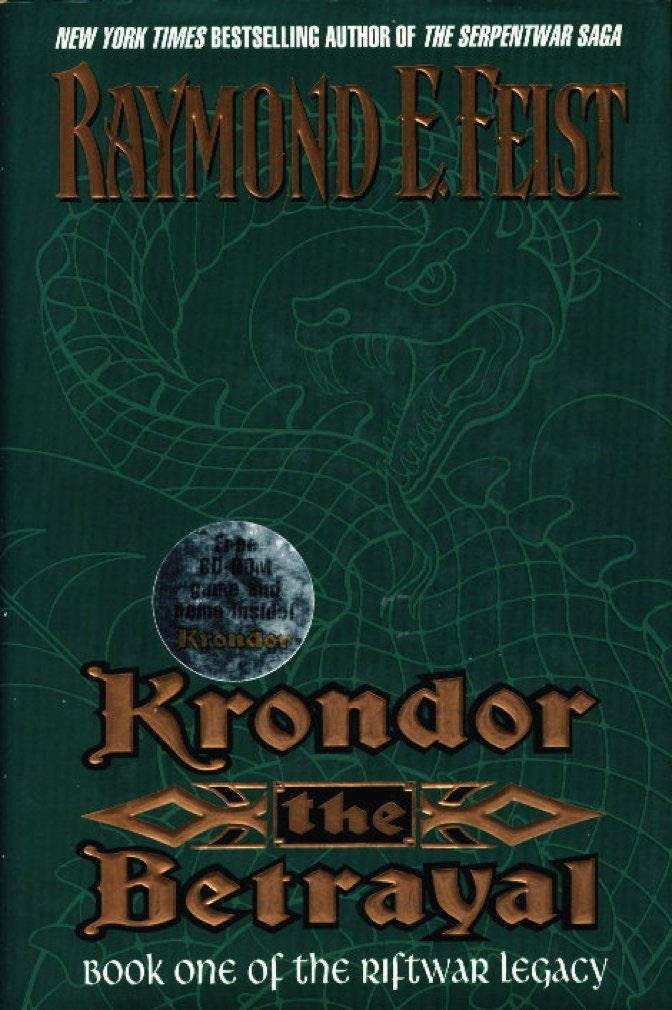
Raymond E. Feist - Krondor: The Betrayal (1998)
Krondor: The Betrayal worked, at least for the first couple hundred pages, as a remarkable litmus test as to its worth staying in my book collection; I tend not to keep anything I see as totally lacking in value, and up until the midpoint it was just barely squeaking by as a keeper; pulp fantasy, deeply unexceptional, but just adequate enough to stay on the shelf. It would have functioned as the exact hinge point between a yes and a no; anything better than it would definitely be kept, anything worse would obviously be donated. That was until Gorath and Owyn were abducted by dark elves and taken into the deadly tundra north of the mountains, after which they complete some simple tasks and escape within thirty pages, rendering the detour utterly pointless and immaterial to the overall plot. Then it went into the trash pile.
I picked up Krondor: The Betrayal mostly because of its strange link to cult CRPG Betrayal at Krondor, which I’ve never personally played but was always curious about from its impressive ads in old issues of Computer Gaming World. It is not a novelization of the game, exactly; the game was developed with the Riftwar IP and some guidance from Feist, who five years later took the core plot of the game and constructed a novel around it. In the afterword, Feist says that he followed the main quest of the game, disposing of most of the side content; this is untrue, but unintentionally. Krondor: The Betrayal is nothing BUT side content, a relentless procession of fetch quests and filler, its overall narrative and stakes so overcomplicated and poorly explained they’re nigh indecipherable. The Riftwar Legacy is a prequel series which assumes familiarity with the primary Riftwar books, but I have serious doubts that such familiarity would improve the overall experience of this book, a chunk of epic fantasy so lugubrious and anonymous that I struggle to recall any pertinent details of the plot a week after finishing it.
The central problem (one of many, but I have to limit myself somewhere) is that of stakes: Feist seems to be utterly incapable of understanding what scenes are significant and which aren’t, resulting in him treating major character deaths with the same weight as yet another fucking trip across the map on horseback. It’s not that Krondor is entirely without incident; it’s that every obstacle placed in the path of the adventuring party is effortlessly defeated, rendering those challenges little more than speedbumps on the way to a final confrontation with… wait, who is the primary antagonist of the book again? Feist isn’t sure; he suggests it to be half a dozen nefarious characters over the course of the novel, all of whom get knocked down like so many bowling pins, anticlimax after anticlimax piling up into a mountain of undifferentiated sludge constructed by characters so paper-thin and archetypal they barely exist on the page. It’s astonishing that Feist managed to drag out such a threadbare narrative for 400 fucking pages, the vast majority of the book dedicated to plot beat breadcrumbs that inflate the word count but offer literally zero impact upon the story itself. Case in point: can you imagine a scene where your adventuring party is tasked with stealing an eightball of Wizard Coke from the home of a local ruffian? Can you imagine what might happen, the things that might go wrong, the spiral of unintended consequences which could reverberate through the texture of the book? Here’s how Feist handles it: a character walks into the house, finds the bag, and walks out. I need to stop reading fantasy for a while. This shit sucks.
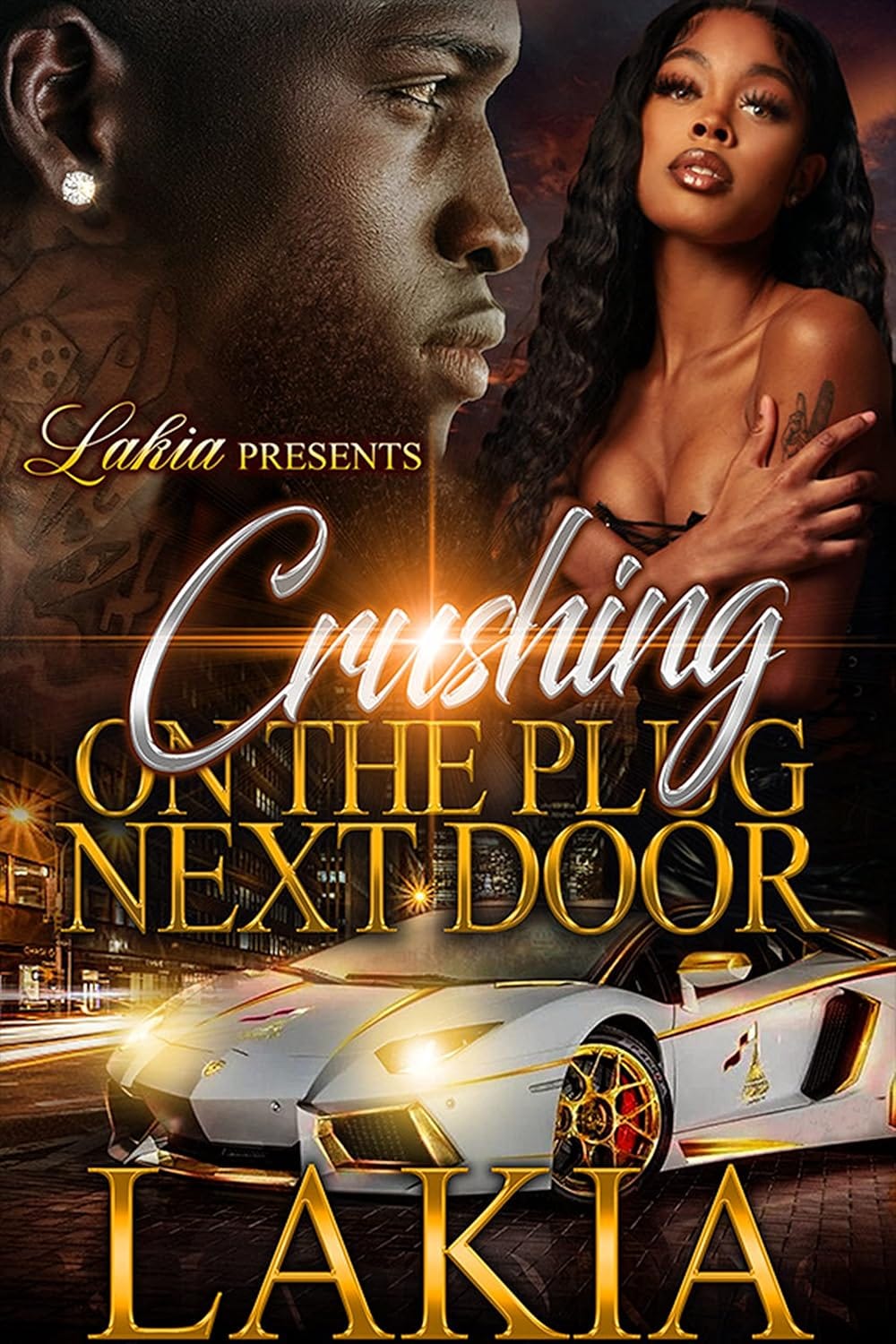
Lakia - Crushing on the Plug Next Door (2023)
A little over two years ago, while very stoned, I regaled my girlfriend with the lore of Quan Millz, ratchet fiction extraordinaire. Like most sensible people, we laughed riotously at the utterly insane covers and descriptions of his various novels; I still plan to give some of his work a serious shot one day. But I was intrigued by how, rather than merely springing unbidden from the collective id of 4chan, his work appeared to function as a kind of satire of an entire genre of fiction nearly invisible to the general reading public, euphemistically dubbed “urban romance.” With that in mind, I wanted to see it first hand, so after a brief session of digging through potential candidates, I settled on Crushing on the Plug Next Door, imagining it to be sufficiently representative and generic for my purposes. What ensued, over a very long period, in fits and starts, was my girlfriend and I reading the book out loud to one another, cover to cover. I am intrigued by the idea of utterly unique experiences, no matter how petty and essentially pointless. I imagine we are the only people in the world to have heard every line of Crushing on the Plug Next Door spoken aloud. I am almost certain I own the only copy of Crushing on the Plug Next Door that has come into physical contact with a copy of Pierre Guyotat’s Eden Eden Eden. Like I said- trivial, but very amusing.
Wait, you want to know if the book is bad? Of course the fucking book is bad! Crushing on the Plug Next Door is simultaneously hilarious and interminably boring, its utterly deranged characters frantically flip-flopping between utter sociopathy and gushing romance inside of single paragraphs and its plot largely inconsequential until the cliffhanger ending, installed purely to split a single narrative into a book that can be sold twice. Its double narrative setup allows for a wider audience to self-insert: Anya, type A frosty professional with a tender, wounded heart, and Yola, messy ratchet hoe stereotype with dialogue and behavior so deeply outrageous the SPLC has labeled her mere existence a hate crime. While the book features all the excess and insanity suggested by the cover, the actual reading experience is largely a dreary affair. The central fantasy is not the romance so much as an aspirational lifestyle, an endless procession of conspicuous consumption and designer products described with all the love and energy which, in another book, would be reserved for human characters. Every line of the book drips with a deeply unlikeable, nearly unsettling quality; that any part of it is aspirational renders it more a horror than a romance. Combine that with a barely functional writing style so slapdash and unedited it’s occasionally unreadable- the title of the book is misspelled on the spine- and you have an artifact of utterly degenerate, narcissistic hideousness that is extremely amusing when read aloud but utterly pointless outside of that. But it sure has value in that mode: you will cackle continuously at every line of insane dialogue, cringe-inducing sex scene, and interminable description of supercars and penthouse apartments. If, for some absurd reason, you desperately wanted to read the novelization of a Megan Thee Stallion song, here’s your winner.